
Help! How Should I Schedule My Homeschool Day?
What should our homeschool schedule actually look like? The answer is different for every family. From structured school days to flexible weekly goals, project-based learning, or a little bit of everything, there’s no single “right” way to homeschool. Find what works for your family!
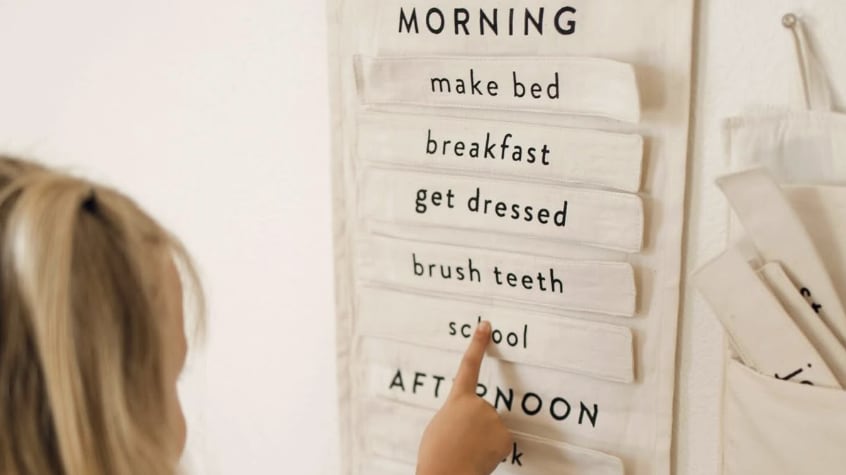
The crisp air of fall is finally here!
The seasons are changing, and there are signs everywhere: the sun rises a little later and sets a little earlier each day, leaves are slowly turning, and pumpkin spice is slowly invading the air.
The signs aren’t only visible outside, either. They’re showing up inside our home, too.
Now that the sun isn’t setting after 9:30 p.m., the boys’ bedtime routine is back on schedule, and with it comes a much more reasonable wake-up time—versus the 5:00 a.m. wake-ups with the crack of dawn we experienced all summer.
But the most significant change?
Learning is back in full force.
Extracurriculars, co-ops, lessons, activities, new routines, and all the excitement (and chaos!) that come with a new school year have finally settled down, and things are beginning to feel a little more routine.
And with all the things going on, I keep wondering: What should our homeschool schedule actually look like?
As I look around, I’ve noticed that all of our homeschool friends have completely different schedules, routines, rhythms, and ways of approaching education at home. Some have their days mapped out hour by hour, while others have a list of things they want to accomplish each week and figure it out as they go.
And honestly? That’s one of the beautiful things about homeschooling.
There isn’t one schedule that works for every family.
Here are some of the most common ways families structure their homeschool days and weeks. Think of these less as rules and more as templates that you can adapt to fit your children, your family, and the season of life you’re in.
1. Traditional School-Day Schedule
A homeschool day is divided into subjects with set times, similar to a traditional school.
For example:
-
8:30–9:00 — Morning routine
-
9:00–9:45 — Math
-
9:45–10:30 — Reading
-
10:30–11:00 — Break
-
11:00–12:00 — Science
-
1:00–2:00 — Social Studies
-
2:00–3:00 — Art or PE
This can be a great fit for families who enjoy predictability, routines, and clear academic expectations.
2. Block Scheduling
Instead of covering every subject every day, families dedicate larger blocks of time to particular subjects.
For example:
- Monday/Wednesday: Math + Science
Tuesday/Thursday: Reading + Social Studies
Friday: Projects, field trips, art, and catch-up
This can work especially well for older students or families who prefer spending more time going deeper into a topic.
3. Loop Scheduling
With a loop schedule, subjects are placed in a sequence rather than assigned to specific days.
Math → Reading → Science → Art → History → Nature Study
If you don’t get to science on Monday, you simply pick up where you left off the next time. There’s no need to “make up” a missed subject.
It offers some structure without making you feel tied to a calendar.
4. Weekly Scheduling
Instead of planning every hour, parents create a list of what needs to happen throughout the week.
For example:
-
4 math lessons
-
4 reading lessons
-
2 science activities
-
1 history lesson
-
2 art sessions
-
1 library visit
-
1 nature outing
The family decides when to complete each activity. Some of our homeschool friends have basically told me, “I don’t care when it gets done, as long as it gets done!”
And honestly, I get it.
This approach offers flexibility while still giving you academic goals to work toward.
5. Project-Based Scheduling
Academic subjects are organized around a larger project or topic rather than taught separately.
A study of the ocean, for example, could include ocean books for reading, marine ecosystems for science, measuring ocean depths for math, a research project for writing, ocean art, geography, and a field trip to the aquarium.
It’s a great approach for hands-on learners and families who enjoy connecting different subjects through one big topic.
6. Interest-Led or Child-Led Learning
Here, your child’s interests help determine what they study and when.
A child fascinated by dinosaurs might spend several weeks reading dinosaur books, creating models, researching fossils, writing stories, and visiting a natural history museum.
There can still be academic expectations, but there is much more flexibility in how those expectations are met.
7. The Hybrid Schedule
And then there’s the approach I suspect many homeschool families eventually find themselves using: a little bit of everything.
You might have structured academics in the morning, outdoor or nature-based learning midday, and co-op, art, sports, or project-based learning in the afternoon.
Maybe math and reading happen consistently each morning, while science, history, and art happen through projects, books, outings, and hands-on activities.
For many families, this balance provides enough structure to keep things moving while still leaving room for life to happen.
8. Four-Day or Year-Round Scheduling
Not every homeschool family follows a traditional September–May calendar.
Some homeschool year-round with shorter breaks throughout the year. Others homeschool four days a week and reserve one day for field trips, co-op, appointments, nature study, errands, projects, or simply catching up.
So… What’s the “Right” Schedule?
I’m learning that there really isn’t one.
Your homeschool schedule can be structured, flexible, or somewhere in between. You can have academic lessons, unstructured play, extracurriculars, child-led exploration, and plenty of downtime all within the same week.
The beauty of homeschooling is that you get to build an education around your family—not force your family into an educational schedule.
So if your schedule looks completely different from the homeschool family next door, that’s okay.
It’s not supposed to look the same.
The goal isn’t to create the perfect homeschool schedule. It’s to create one that works for your children, your family, and the season of life you’re in.